Launching a podcast in 2026 has the kind of rewards that were not observed before. The landscape for podcasters has become more challenging. There are millions of podcasts on various platforms as we speak. A podcast launch strategy has exceeded just pressing the record button.
A powerful launch strategy is about being discovered. You establish yourself as an authority and cultivate a loyal following. A great podcast launch strategy can be a powerful growth tool. Develop a strategy that lives up to the hype.
Growth Professor Studios has witnessed that the podcasts that succeed are not always the ones with the deepest pockets. They are the ones with clarity and consistency as well as the right market positioning.
What You Need to Start a Podcast in the First Place?
Want to know how to launch a podcast in 2026? The answer is that it has never been easier!
Here is a brief idea of what you need:
| Tier | Budget | What You Get |
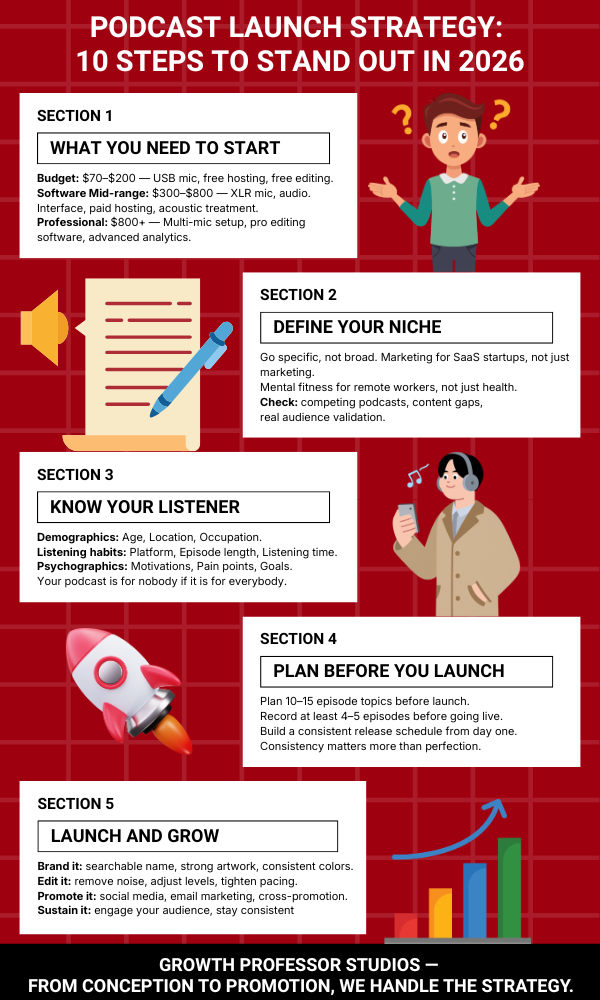
Budget | $70-$200 | USB microphone Earbuds or headphones Free hosting on Spotify Free editing software |
Mid-range | $300-$800 | XLR microphone Audio interface Great headphones Paid hosting Acoustic treatment |
Professional | $800+ | Multi-microphone setup Nice recording room Video cameras Pro editing software Hosting with advanced analytics |
Crucial steps that can rock your launch are given below.
Step 1: Define a Niche That Actually Matters
Select a good niche. That is one of the most important components of your podcast launch strategy. Avoid broad topics such as business or fitness. Try to focus on a particular segment.
For instance:
Try marketing for SaaS startups instead of marketing.
Try mental fitness for remote workers instead of health.
You are making your podcast more visible by selecting a particular segment.
Consider the following factors before you select a particular segment for your podcast:
- Competing podcasts
- Content gaps
- Validation with real people
Step 2: Know Your Target Listener
Skip this step and your podcast will suffer! Build a comprehensive picture of your ideal listener. This includes more than just demographic information. Consider:
| Category | Details |
| DEMOGRAPHICS | |
| Age | [Age range of your audience] |
| Location | [Location or setting] |
| Occupation | [Job title, industry, seniority level] |
| Education | [Educational background] |
| LISTENING HABITS | |
| Primary Listening Time | [Morning commute, during exercise, lunch break, etc] |
| Preferred Platform | [Spotify, Apple Podcasts, YouTube, etc] |
| Preferred Episode Length | [15-20 min solo or 30-45 min interviews] |
| CONTENT PREFERENCES | |
| Preferred Format | [Interview, solo, narrative, panel, etc] |
| Favorite Genres | [Top podcast categories they listen to] |
| PSYCHOGRAPHICS | |
| Primary Motivations | [Why they would listen to you] |
| Pain Points | [Professional or personal challenges] |
| Goals | [What they hope to learn or accomplish] |
| SOCIAL BEHAVIOR | |
| Social Media Platforms | [Where they spend time] |
| Podcast Discovery | [How they find new shows] |
Every choice becomes easy when you know your listener well. The simple truth is that your podcast is for nobody if it is for everybody. Find a balance.
Step 3: The Right Podcast Format
The format of your podcast will dictate your entire experience. There are three main formats:
- Solo: Perfect for authority-building and control
- Interview-style: Perfect for networking and audience-building
- Panel-style: Good but difficult to pull off
A lot of successful podcasters use a hybrid format. They combine solo-style insights and interviews with experts. This keeps things fresh and allows your content to evolve.
Step 4: Plan Episodes Before You Launch
A mistake often ignored by podcast launch guides is the need for proper planning. Don’t launch a podcast with only one episode.
Instead:
- Plan 10-15 episode topics before you launch
- Record at least 4-5 episodes before launch
- Develop a consistent schedule for releasing episodes
- You want to be consistent, and consistency is one factor for podcast growth.
Step 5: Set Up Your Equipment and Space
You do not need the best equipment for podcasting. You still need good audio. The equipment you need is a microphone.
As a beginner:
- You can use a USB microphone for a quick fix.
- An XLR system for better quality must be used.
- You also need a recording space. A quiet room with a lot of padding can improve the quality of your podcast without extra cost.
Step 6: Name and Brand Your Podcast
Your podcast name and artwork are the first things your audience will encounter. They matter.
A great name should be or have:
- Easy to search for
- Relevant to your niche
- Easy to remember
- Your podcast branding should include:
- A catchy artwork
- Colors and fonts are consistent throughout the podcast
- A short description that is compelling
Step 7: Record and Edit and Polish
Editing makes your podcast sound professional.
Editing entails:
- Removing background noise
- Adjusting volume levels
- Enhancing pacing
There are different editing approaches to choose from:
- Light editing: natural editing
- Standard editing: simple editing
- Premium editing: top-notch editing
Step 8: Distribute and Promote Strategically
Your podcast host distributes your episodes to platforms such as Spotify and Apple Podcasts. That is not the only step. You have to promote your podcast.
An excellent launch strategy for your podcast entails:
- Promotion before the launch
- Social media promotion
- Cross-promotion
- Email marketing
Promotion of your podcast has to occur before the launch.
Step 9: Build Momentum After Launch
More about the momentum than the launch. The real work begins after the launch.
Your focus should be on engaging your audience. Consistency and engagement are the keys to success.
Conclusion
If you want to launch a podcast in 2026, it is not enough to have a great audio experience. You need a great podcast launch strategy. This means from defining your niche to promoting your podcast, everything is important for success. A great podcast launch strategy can rise above the noise and build a loyal fan base eventually.