One of the most important discussions in modern podcast marketing is whether or not podcast videos should be included. With the emergence of branded podcast videos, this is one of the biggest debates in modern marketing. This is no longer a simple matter of answering yes or no.
At Growth Professor Studios, we’ve witnessed many brands jumping into video podcasting, expecting instant growth, only to find out that video is not a magic switch. Video is a multiplier. It will multiply your results if you’re using it correctly, or it will suck all your time and money dry.
The debate is no longer about whether video is the future. The debate is about whether video is the right choice for your podcast at this particular moment. Let us dive into the opportunities and strategies for video podcasting for brands.
Curious Cases of a Branded Podcast Video Strategy
1. Content Diversification at Scale
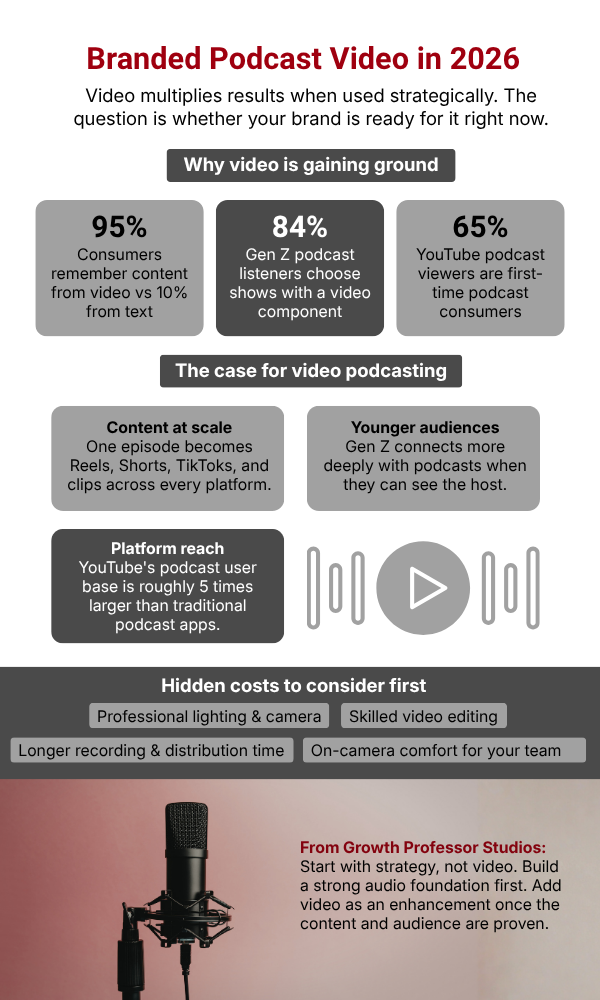
One of the most powerful reasons for creating a video podcast for your brand is the ability to repurpose your content. Instead of sticking to audio, video allows for:
- Instagram Reels
- YouTube Shorts
- TikTok clips
- Social media snippets
And the data on video performance only serves to further convince us of the power of video.
- Tweets with video perform 10 times better than tweets with no video.
- 62% of people will watch videos under 60 seconds all the way through.
- 95% of what consumers say they will remember comes from video. Only 10% comes from text.
These statistics all add up to the same idea. Video holds attention. And with the ability to create short video clips out of your podcast, you can reach people who may not necessarily seek out podcasts. Direct them to your full episodes on Spotify or YouTube.
2. Reaching the Younger Audience
Video is becoming a key element for you if you have a younger audience in Gen Z.
Here is a breakdown of the stats:
- 49% of Gen Z monthly podcast listeners report that video helps them understand the podcast more because of facial expressions and tone.
- 45% of podcast listeners report that they feel more connected to the podcaster when video is included.
- 84% of Gen Z monthly podcast listeners consume podcasts that have a video component.
But perhaps the most compelling figure is this one:
65% of podcast viewers on YouTube are new podcast consumers.
This means that video is not just making the experience better for those who are already engaged. It is also growing the overall audience potential for you.
3. Discoverability Through Major Platforms
Let us step back and look at the scope of this opportunity.
Podcasts have 89 million weekly listeners in the US. YouTube has 197 million users in the US. 62% use the platform daily.
This disparity underscores the power of video:
The user base for YouTube Podcasts alone is roughly 5 times larger than the user base for traditional podcast apps.
In fact:
YouTube Podcasts already reaches 34% of the podcast user base. This is a platform that is still relatively new to the podcasting game.
But what about Spotify? They are accelerating their video push:
- Video podcasts on Spotify have grown by 70% over the past year.
- There are now 250,000 video podcasts on Spotify, up from 100,000.
- Spotify for Podcasters has been renamed Spotify for Creators.
The Hidden Costs of Video Podcasting You Should Be Aware of
There are some things you should understand before you jump into video podcasting. Video podcasting is much more complex than setting up a video camera.
1. Production Complexity
Creating a high-quality video podcast demands:
Lighting and camera work by professionals
Creating branded background visuals
Having on-camera hosts and guest talent
Having skilled video editors to work on the video podcast
If these are not met, your video podcast may look amateurish and may end up harming your brand instead of helping it.
2. Time and Budget Investment
Creating video podcasts demands:
More time spent on recording, as multiple takes may be necessary
Time spent on editing the video podcast, as this may be necessary
More time spent on distribution, as this may be necessary
All these may be a challenge for some brands, especially if video podcasting does not help them grow.
3. On-Camera Challenges
Having a video podcast can bring additional pressure, especially if your team is diverse.
Not everyone may be comfortable on camera, and this may be a challenge. This may be another factor that may be ignored when determining whether video podcasting can work for your brand.
What Platforms Are Signalling for a Video Podcast in 2026?
The drive towards video is not arbitrary; it is driven by the platforms.
YouTube’s Dominance
YouTube has rapidly emerged as one of the most significant platforms for podcast consumption. The advantages of using YouTube for podcasts are:
- Vast audience size.
- Effective recommendation engine.
- Features such as comments and subscriptions for the community.
- Even posting static audio with an image cover will increase visibility.
Spotify’s Video Push
Spotify is heavily investing in video, with features such as:
- Uploading native videos.
- Ad-free video experience with a premium membership.
- Exclusive deals with creators.
The shift towards video has its own costs. The lack of transparency in the analytics and the changing nature of the monetization strategy.
Conclusion
The opportunity for podcast video is a major one in 2026, as it can help you grow your audience by leaps and bounds, increasing your podcast’s potential to become a true powerhouse of content. The smart play for podcasters is to create a strong foundation of audio content. Only then you expand into video as it depends on the data and the audience.