Podcasts may survive poor introductions and unattractive episode titles. Or even long pauses. However, podcasts do not withstand bad audio quality in any way. Listeners tolerate numerous defects in audio except echo, static noises, and muffled sounds. The best podcast microphone is much more important than fancy branding.
Key Takeaways
- The choice of the podcast mic depends on the conditions where you plan to use it.
- The USB podcast microphones are perfect for beginners since they are inexpensive and simple.
- The XLR microphones provide professional sound quality and more personalization.
- Good acoustics in the room and proper microphone placement are more helpful to achieve audio quality.
- The use of artificial intelligence software allows eliminating background noises and echoes.
- The use of an appropriate microphone will enhance engagement and increase the professionalism of your podcast.
A radio station is not required to get professional audio quality. Many great modern options provide studio quality for all types of recording. From bedrooms to office rooms and even cars. Each creator who records podcasts can get a suitable and quality microphone regardless of their budget.
This article outlines the best microphone for podcasting based on your equipment and the type of content you produce. The following suggestions will help you feel confident even before the first words reach your audience’s ears.
Want the professional feel for your podcast?
Our experts at Growth Professor Studios help creators develop professional content creation systems. Join us and be better.
Why Your Podcast Microphone Is Much More Important Than Your Camera
Unlike videos that rely heavily on visuals, podcasts are all about listening. Clear voices can help establish authority. Bad audio can cause fatigue and drive your audience away before your ideas are heard.
Quality microphones contribute to clearer voices, lower ambient noise levels, and easier editing processes. They also reduce production time as less editing is needed for better recordings.
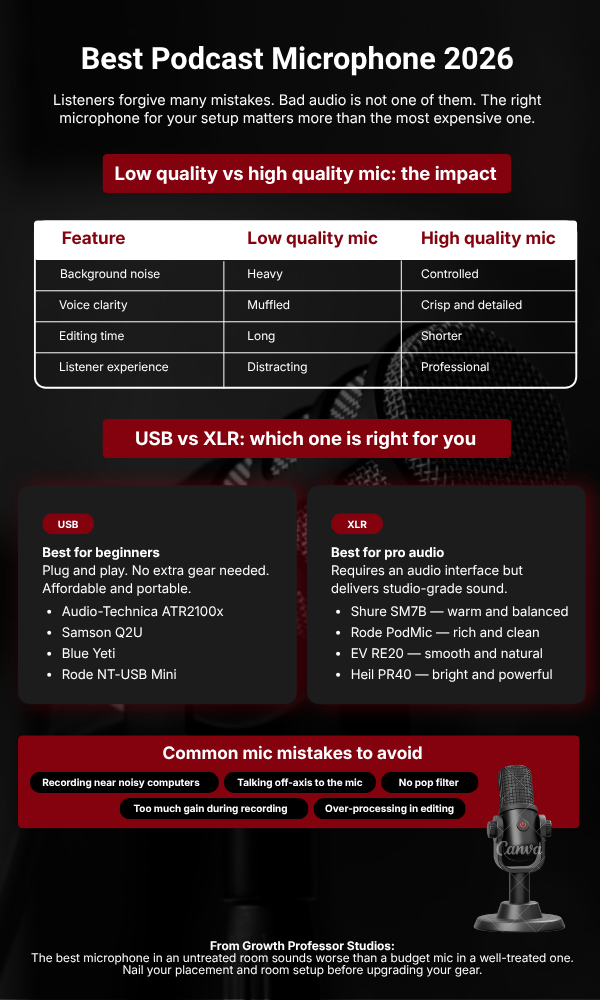
See below a quick comparison of how the microphone influences your podcast.
Feature | Low Quality Mic | High Quality Podcast Microphone |
Background Noise | Heavy | Controlled |
Voice Clarity | Muffled | Crisp and detailed |
Editing Time | Long | Shorter |
Listener Experience | Distracting | Professional |
Recording Flexibility | Limited | Versatile |
USB Microphones for Beginners to Podcasting and Other Professionals
A USB microphone is quite simple and excellent for beginners at podcasting. You will just have to plug it into your computer. The ideal USB microphone for new podcasters should be a simple one.
Some of the top USB podcast mics for newbies are:
- Audio-Technica ATR2100x
- Samson Q2U
- Blue Yeti
- Rode NT-USB Mini
Pros and Cons of USB Podcast Mics
Pros
- User-friendly installation
- Budget-friendly price tag
- Compact and portable
- Perfect for solo podcasts
Cons
- Not as much room for upgrades
- Minimal ability to customize audio quality
- Tendency to pick up keyboard sounds
XLR Podcast Microphones for Pro Audio Quality
When you want studio-quality sound for your podcast, an XLR microphone is the way to go. An XLR mic needs an external audio interface or mixer but provides deep vocals.
Top XLR podcast mics include:
Microphone | Best For | Sound Profile |
Shure SM7B | Deep radio voice | Warm and balanced |
Rode PodMic | Budget studio setup | Rich and clean |
Electro-Voice RE20 | Broadcast podcasts | Smooth and natural |
Heil PR40 | Detailed voice work | Bright and powerful |
The best podcast microphone? Varies greatly based on your room, vocal timbre, and recording process. The finest microphone in an untreated room would sound less ideal than a cheap microphone in a treated room.
Podcast Microphone Selection Based on Room Characteristics
The room plays just as big a part in the recording process as the microphone. Echo and background noises result from hard surfaces, empty rooms, and loud fans.
Dynamic mics are perfect for untamed rooms since they pick up less ambient noise. Condenser microphones produce higher-quality recordings but demand more tranquil settings.
Follow this basic tutorial for setup.
Recording Space | Recommended Mic Type |
Bedroom Studio | Dynamic |
Professional Treated Room | Condenser |
Shared Apartment | Dynamic |
Mobile Recording | USB Dynamic |
Expert Tip
“Learning the correct placement and room setup of your podcast microphone will yield far better results than just purchasing one.”

Daniel Carter
Podcast Producer & Audio Engineer
The Worst Podcast Microphone Mistakes for Beginners
Podcasters invest in costly gear before even knowing proper microphone technique. No matter how good the podcasting microphone may be, poor positioning will make it sound bad.
Many talk too far from the microphone. Others record in bare rooms, where loud reflections degrade sound quality. Minor mistakes can make a huge difference.
Here are some common problems to watch out for.
- Recordings taken close to noisy computers
- Talking off-axis to the microphone
- Recording without a pop filter
- Applying too much gain during recording
- Applying too much noise reduction during editing
Start a podcast that sounds big! Big and professional!
Big and professional! Let us help you pick the right equipment and create a better workflow. Reach out to Growth Professor Studios now and watch us pull off wonders for you.
Conclusion
The most expensive podcast microphone may not always be considered the best podcast microphone. Your choice will depend on factors. Those include your studio, recording experience, workflow and your expectations from the podcast. USB microphones provide convenience and affordability for beginners. XLR microphones enable professional sound quality for experienced users. Both will perform well if you use good techniques in recording.
FAQ
The choice of the best microphone for podcasting depends on your equipment and finances. Beginners may opt for USB mics. Experts often choose XLR microphones.
Yes. AI audio tools can help to eliminate fan sounds, keyboard noise, reverberations and static.
Yes. However, the quality of sound may be lower compared to professional microphones.
Make sure that you optimize the room acoustics. Ensure proper placement of the microphone. Eliminate background noises and record at the same volume levels. The simplest changes make greater improvements than costly upgrades.
Some of the top microphones for budget podcasters include the Samson Q2U and Audio-Technica ATR2100x due to their superb sound quality and value for money.
One Response