There is no need for a podcast to be created in a studio setting only. Sometimes the most interesting podcast stories can be created during an attendance at a trade show or even a visit to a client. That is why portable podcast studios have gained popularity.
Key Takeaways
- Possible to make a professional recording from anywhere if you have a portable podcast studio.
- A dynamic microphone will perform better if there is noise.
- The recording devices allow greater control.
- Using headphones, you will be able to correct errors.
- Proper power management will prevent interruptions.
- The best portable podcast studio is the one that you can use when an inspiration hits you.
The field recording can help you do a lot. Good podcasters can record sound anytime and anywhere. However, what is really difficult is making a professional sound recording in any condition.
There are various kinds of modern portable equipment solutions for podcasts available currently. Specific types of gadgets make the process of creating a good recording possible with minimal effort. Learn about the equipment that will help you create a professional podcast using field recording.
Improve Your Recording Setup Now!
At Growth Professor Studios, we can help producers construct portable recording setups that produce professional audio.
Why Does Portable Podcasting Evolve Continuously?
Many people love podcasts because they use an authentic approach. Their discussions should take place where they happen. The advantage of using the mobile approach is that one can capture sound and interviews live on the spot.
Portability also makes things more flexible. One is able to create content while travelling or attending exhibitions without the requirement of going to your regular studio.
Field recording also allows one to be able to interview individuals who might not want to visit your studio.
Main Components of a Portable Podcast Studio
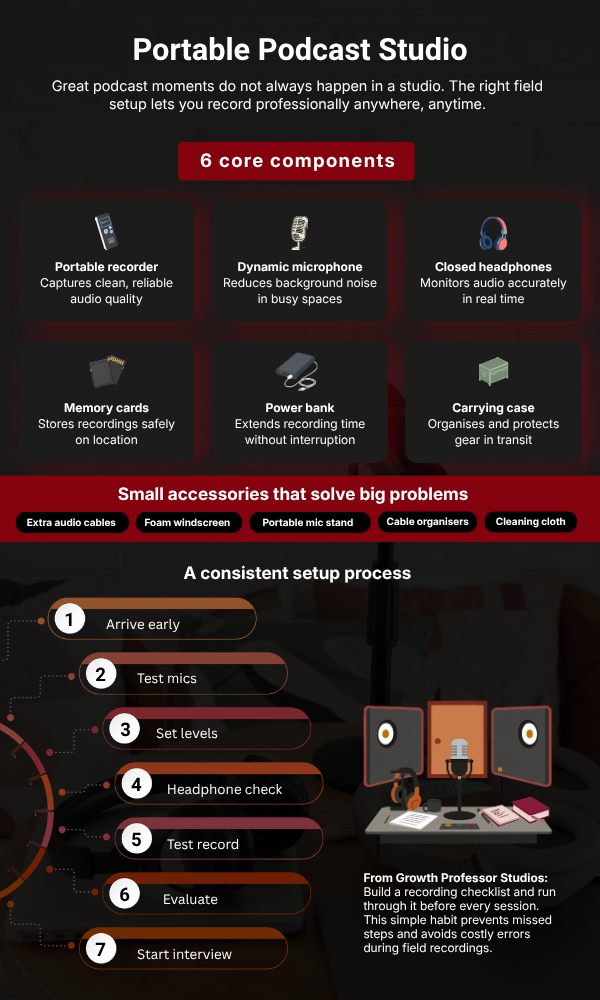
Here are some of the main components needed to make your portable podcast studio a success.
Equipment | Purpose |
Portable recorder | Captures quality audio |
Dynamic microphone | Reduces background noise |
Closed headphones | Monitors audio accurately |
Memory cards | Stores recordings safely |
Power bank | Extends recording time |
Protective carrying case | Organizes and protects gear |
Each plays its part in making the process of recording a reliable one.
Selection of Microphones for Field Recording
The selection of microphones will be the most important factor, impacting the final sound more than anything else.
Dynamic microphones fit field recording due to their ability to record only the closest sounds while blocking most other sounds from their environment.
Podcast makers begin with a basic set of podcasting equipment which includes a few dynamic microphones and one handy recorder. Such a combination does its work pretty well.
Consistency outweighs price. It’s always better to do everything correctly using one relatively inexpensive microphone than to misuse an expensive one.
Monitoring Audio During Recording
Earphones guarantee the quality of your recordings.
You won’t know if there is any background noise or volume changes during your session without audio monitoring. Is it too late to correct something? It is already too late.
Closed earphones block external noise and help you spot any recording problems right off. They also make sense when working in crowded places.
Professional podcast producers rarely go into field recording without headphones.
Why You Should Manage Power Well
Most problems while doing a field recording usually come from dying batteries rather than faulty equipment.
Bring backup batteries or a big power bank. Make sure that you test all of your devices before embarking on field recordings. Make sure you charge all the equipment one day before going out there.
It offers you plenty of safety because you can always be prepared. More so during important interviews.
What Accessories Should You Carry With You?
Many people concentrate on the microphone and recording devices. They forget that it is accessories that make your recordings successful.
Some accessories that you may consider carrying around are:
- Extra audio cables
- Foam windscreener
- Memory cards
- Portable mic stands
- Organizers for cables
- Cleaning cloth
They do not occupy too much room and solve many problems.
Expert Tip
“Make sure to create a recording checklist and always go over it before each recording session. The practice will help avoid missing anything and prevent errors in field recordings.”

Michael Carter
Audio Production Specialist
Designing an Efficient Setup Process
Conditions in the field recording area change rapidly. There is a chance that guests have very few time resources. An event might become crowded. The weather might change.
A Consistent Process of Setting Up
- Arrive early.
- Test your mics.
- Set your recording level.
- Listen using headphones.
- Test record for a while.
- Evaluate the test record.
- Start your interview.
Build an Even Smarter Podcast Studio!
Growth Professor Studios offers suggestions to podcasters who desire to maintain professional standards without facing hassles. Develop a podcast recording space that can accommodate your needs.
Conclusion
The most portable podcast studio depends on being prepared rather than being too equipped. A good recording device. Mics. Headsets. Power supplies. All of this equipment and other accessories can enable you to build a portable recording studio. Start small. Build from there. Keep it easy.
FAQ
A portable recorder. A dynamic microphone. Good headphones. A way of storing your content and power backup and a reliable case for your portable studio.
A quality portable recorder with one or two dynamic microphones. A pair of headphones. Proper power supplies make a great setup.
Field recording involves recording interviews and conversations with the help of portable audio equipment and listening to them with headphones.
A mic. Recorder. Headphones. Backup power. Memory cards and extra equipment.
A recorder to carry around. At least one mic. Headphones and some extra equipment accessories. All that a beginner can start with.